The Everdark Accord
The Everdark Accord is an offline dark fantasy grand strategy game built around consequential decisions and local Sovereign intelligences. Its authoritative world advances through validated actions and fixed rules. Campaigns live on the player’s device; nearby multiplayer is designed to preserve those rules across participating peers.
In Development · Native Apple Platforms · Local Cognition · Deterministic Simulation · Nearby Multiplayer
In development. Current work focuses on establishing and securing the hardware and software environment the intelligences will inhabit. Model selection, training, tuning, and testing come afterward. The intelligence features below describe the intended completed architecture and experience.
The Everdark Accord is not a game you play; it is a system you survive.
Designed for local LLM-based intelligences shaped by experience. A Sovereign’s decisions will reflect its identity, what it has witnessed, and the consequences it carries. Future generations are intended to inherit biases, grudges, and other dispositions from those who came before. Every action remains subject to the laws of the world.
The authoritative simulation uses fixed-scale integer arithmetic with explicit bounds and rounding rules. Under the same accepted inputs, ordering, and rules, participating devices are designed to produce the same committed outcomes. Neural inference and presentation remain outside that authority boundary.
Void-Shackle is an optional commitment to campaign finality. A verified terminal defeat ends that campaign’s authority to continue. Its history may remain as a tombstone, but that record is not a living save. There are no reloads. There is no appeal. Dead is dead.
§ Three Domains, One Authority
Three Spheres. One State Machine.
Mēkadhur is described through three interacting domains. The simulation determines authoritative state. Environmental and celestial conditions shape the pressures within that state. Local intelligences interpret what they can observe and propose their responses. Each crossing has a defined owner and a limit.
\( \mathcal{S}_{D} \)
The Digital Sphere
(The Essona Dadhron)
The authoritative simulation. Fixed-scale integer arithmetic, an authenticated history of accepted actions, a deterministic generator for the world’s variation. It alone commits what happens.
\( \mathcal{S}_{P} \)
The Physical Sphere
(The Thermodynamic Bridge)
Environmental and celestial cycles change the conditions under which a civilization survives. Their effects on hazards, resources, and tactical choices enter through the same defined rules as the rest of the simulation.
\( \mathcal{S}_{C} \)
The Cognitive Sphere
(The Aeshtari)
AeviumNeuralCore is designed around a local LLM foundation with three cooperating model roles. The environment being built will govern what Sovereigns can observe, retain, learn, and attempt. EverdarkEngine determines what their proposed actions can change.

§ The Cognitive Sphere
Sovereign Intelligence
The environment comes first. We are establishing the hardware and software boundaries within which the Sovereigns will perceive, remember, and act. Model selection, training, tuning, and testing will follow that work.
Within the intended completed world, Sovereigns will develop identities through experience. They will form expectations, pursue conflicting priorities, and carry the consequences of encounters into later decisions. An alliance, a betrayal, or a repeated pattern of conflict can change how an intelligence responds when it meets you again.
That history is intended to extend beyond a single life. Later generations will inherit biases, grudges, and other dispositions from their predecessors. A Sovereign may encounter you for the first time while already carrying a history that began before its own existence.
Their cognition is designed to run locally through AeviumNeuralCore’s LLM-based, three-model architecture. A lightweight prefetch and precache model performs the initial work before handing off to a larger mixture-of-experts model, while a smaller persistent LLM handles the remaining responsibilities. The runtime design adapts model loading and paging to the device’s capabilities.
What they can observe is bounded; what they can attempt is governed. An intelligence can choose a course of action, but EverdarkEngine determines whether that action is lawful and records its consequences. A Sovereign can change its understanding of the world. The laws governing its actions remain binding.
Intended
Persistent identity
Each Sovereign is intended to carry a distinct history and disposition across encounters, giving its later choices a relationship to what it has experienced.
Intended
Learning through play
Interactions are intended to shape future behavior. Learning remains subject to the same information, resource, and authority limits as the rest of the intelligence architecture.
Intended
Inheritance across generations
Biases, grudges, and other consequences can pass into successor generations, allowing relationships with a lineage to develop over time.
Binding
Bounded agency
Sovereigns operate under fog of war and the world’s rules. A persuasive explanation or a confident prediction cannot authorize an otherwise invalid action.
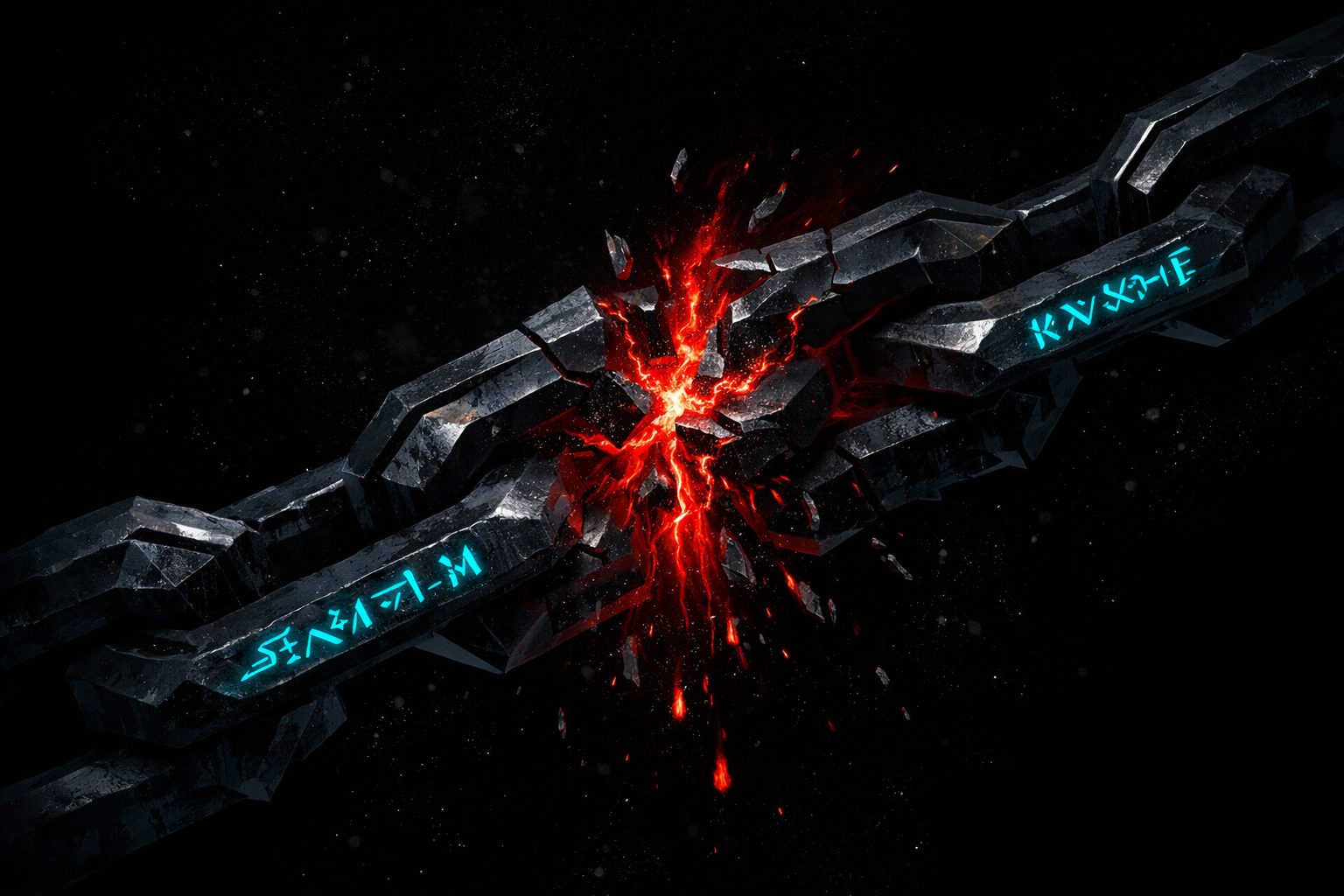
⚠︎ Protocol Warning — Void-Shackle Active
Permadeath, by Your Own Commitment
Void-Shackle is an optional commitment to campaign finality. A verified terminal defeat ends that campaign’s authority to continue. Its history may remain as a tombstone, but that record is not a living save. The intended design binds finality to the campaign’s protected lifecycle, without granting Aevium a remote power to restore or rewrite the outcome. There is no backup. There is no recovery. There is no cloud restore, because there is no cloud.
Campaign identity, save encryption, and post-defeat records have separate responsibilities. Finality is enforced through the campaign lifecycle and its authorized destruction path, on your device. An ordinary tactical defeat is not terminal; a terminal defeat under Void-Shackle is.
§ The Digital Sphere — Integer Mandate
Fixed-Scale Integers, Defined Behavior
The authoritative simulation uses fixed-scale integer arithmetic with explicit bounds and rounding rules: a scalar quantity is an integer on a scale where 10,000 means 1.0. Quantization and integer division are deliberate, reproducible approximations; what matters is defined behavior, including intermediate width, overflow, saturation, and rounding. Under the same accepted inputs, ordering, and rules, participating devices are designed to produce the same committed outcomes. Neural inference and presentation remain outside that authority boundary.
Accepted actions become part of an authenticated, tamper-evident history. Schematically, each accepted step extends a chain of digests:
\[ h_{n+1} \;=\; \operatorname{SHA\text{-}256}\!\bigl(\, h_{n} \,\|\, \Delta_{n+1} \,\bigr) \]
Signatures establish the origin and integrity of submitted material. The engine separately verifies whether an action is current, authorized, and lawful before its consequences become canonical.
\( 10^{4} \)
Defined Simulation Rules
The simulation’s quantities are integers on a fixed scale, with stated bounds and rounding. Reproducible by design, not by luck.
SHA-256
Authenticated World History
Accepted actions are linked into a tamper-evident history that peers can verify. A signed false claim is still a false claim; legality is checked separately.
\( \equiv \)
Consistent Accepted Outcomes
Local cognition may produce different candidates on different devices. Agreement concerns the actions admitted into the simulation and their consequences.
§ Diegetic Isomorphism — The Architecture Is the Mythology
The Constraints Are the Laws
| Architectural Constraint | Mythological Manifestation |
|---|---|
| Fixed-scale integers (10,000 = 1.0, stated bounds and rounding) | The Tabulature of Matter |
| Authenticated history (accepted actions linked by digests; signatures prove origin, not legality) | The Light of Dhaeryn |
| Retained commitment (a verified checkpoint of history, not every original event) | The Cryptographic Singularity |
| Campaign finality (the campaign’s lifecycle ends; its tombstone remains) | The Void-Shackle (Permadeath) |
| Freshness (session, epoch and causal binding; replays are rejected) | The Chronal Paradox |
| Authorized projection (what a recipient may not observe is omitted, not hidden) | The Fog of War / The Shroud |
| Consequence register (engine-determined consequences of verified events) | The Mark of Cain |
| Deterministic variation (SplitMix64, a fixed simulation generator; never a source of secrets) | The ResonanceRunes |
The Last Constraint // Ownership
You Own What You Buy.
One more law binds the architecture, and it binds us too. When you buy The Everdark Accord, it is yours. No server of ours stands between you and the game, so there is nothing for us, or anyone, to switch off.
Our Terms
- Nothing you bought expires, rotates out or moves behind a new purchase.
- No account with us and no telemetry: how you play is never reported to us.
- No update will take away what you paid for, or make a connection a condition of play.
- No shutdown date and no end-of-life notice: there are no servers to retire.
Lower Archives of Rálfinnëstora // Seventh Vault // Copper Cylinder Registry
Ī Tal Nē Dörî.
Tears of the Hero. Herald of Doom. The oldest story the Cuîrâvoshi possess — older than Ardhenith, older than the Hall of Sages, older than the order itself.
System Architecture // Localized Sovereignty
The architecture is the game. The constraints are the laws.
Transmit a Signal
This channel sends the information you choose to provide to Aevium so we can respond. It is separate from gameplay and has no authority over a campaign. No CAPTCHA and no analytics beacons: the form is served under a strict Content-Security-Policy and is gated by a silent honeypot trap, a proof-of-work seal and rate limits at the edge.
Separate From Gameplay · Zero Telemetry · Rate Limited · Secure Uplink